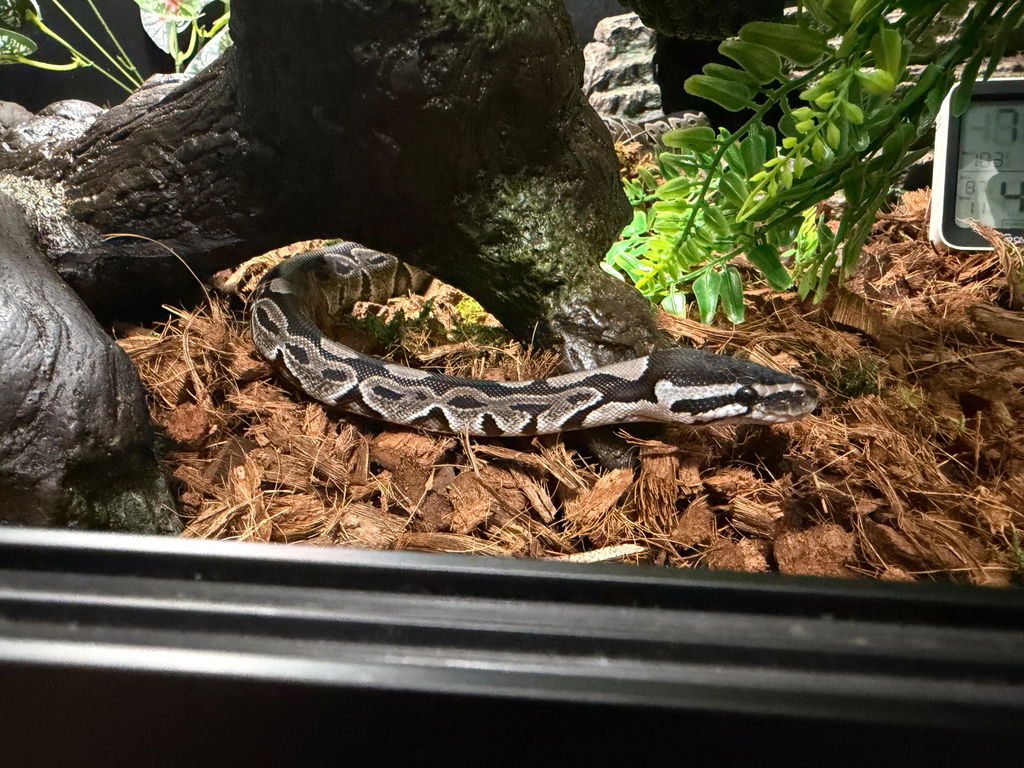
Sizing Up as Your Snake Grows
One of the most common questions we field from new owners isn't about feeding or humidity, it's about enclosure size. And it's a fair question, because ball pythons go through such a dramatic size change from hatchling to adult that a single enclosure rarely works for the entire journey. This guide breaks down what we use in our own facility at each life stage, and why we size the way we do.
Why We Don't Start Hatchlings in Large Enclosures
It might seem intuitive to buy one large enclosure and let your snake "grow into it," but that approach tends to backfire with ball pythons, especially hatchlings. A hatchling placed in a large, open space often shows signs of stress: reduced appetite, more time spent hiding, and a harder time settling into a feeding routine. Ball pythons are naturally secretive animals that spend much of their time in tight burrows and rodent tunnels in the wild, and a hatchling in an oversized enclosure simply doesn't feel secure enough to relax and eat well.
This is exactly why we start hatchlings in small, appropriately sized enclosures rather than sizing up early. It's not about saving space; it's about giving the animal an environment it can actually settle into.
Hatchling Stage: 0 to 6 Months
A hatchling ball python does well in an enclosure in the range of roughly 6 to 10 gallons, or an equivalent small tub, typically somewhere around 12 by 12 inches of floor space or slightly larger. The goal at this stage is a snug, easy-to-heat space with solid hide options on both the warm and cool sides. Too much open floor space at this size makes it harder for the animal to find and hold a comfortable spot, and it makes maintaining consistent temperature and humidity more difficult as well.
Juvenile Stage: 6 Months to 1 Year
As your snake grows through its first year, it's usually ready to move up to something in the 15 to 20 gallon range, or a comparable tub around 16 by 16 inches. This is often a single step up from the hatchling setup rather than a jump straight to adult sizing. We'd rather move a growing snake through one or two intermediate enclosure sizes than force it to adjust to a full adult-sized space too early.
Subadult Stage: 1 to 2 Years
By the subadult stage, most ball pythons are ready for something closer to a 20 to 30 gallon enclosure, or an equivalent tub in the 24 by 18 inch range. At this size, you're also likely dealing with a snake that's more established in its habits and less prone to the stress-related feeding issues that can show up when hatchlings are moved into spaces that are too large too fast.
Adult Stage: 2+ Years
A full-grown adult ball python does well in a 40 gallon breeder-style enclosure, or a tub in the 28 to 32 by 18 to 24 inch range. Larger females on the bigger end of the size spectrum can sometimes benefit from slightly more floor space, but bigger isn't automatically better here. What matters most at every stage is that the enclosure has secure hides, a proper thermal gradient from warm side to cool side, and doesn't leave so much open floor space that the animal struggles to feel secure.
In our own facility, we house adults in rack systems designed specifically for reptile husbandry, which give each animal appropriately sized, secure housing while allowing us to maintain tight, consistent control over temperature and humidity across the entire collection. It's a different look than a display tank, but the sizing principles behind it are the same ones we're walking through here.
Tubs vs. Tanks vs. Racks: What Actually Matters
We get asked fairly often whether a specific enclosure type is "better," and the honest answer is that the container matters far less than what's inside it. A tub, a glass tank, and a rack system can all house a ball python successfully at the right size, provided you can maintain proper temperature gradient, humidity, and secure hiding spots in each one. Glass tanks tend to be harder to maintain humidity in due to more ventilation and surface area for evaporation, which is worth factoring in if you're set on a display-style enclosure rather than a tub.
Signs Your Snake's Enclosure Is the Wrong Size
An enclosure that's too large for a hatchling or juvenile often shows up as reduced appetite, excessive time spent hiding in one spot, or a snake that seems to constantly be searching rather than settling. On the flip side, an enclosure that's become too small for a growing snake can show up as difficulty fully stretching out, or a snake that seems restless and is frequently pushing against the enclosure's edges. If you're noticing either pattern, it's worth reassessing whether it's time to size up or whether you sized up too early.
A Note on Rack Systems for Larger Collections
If you're planning to eventually keep more than a couple of ball pythons, it's worth knowing that rack systems exist specifically to solve the space and consistency challenges that come with housing multiple animals at different life stages. A rack system uses individual, appropriately sized drawers or tubs stacked within a shared frame, often with centralized heating that makes it easier to maintain consistent temperature across many animals at once. This isn't necessary for a single pet snake, but it's worth understanding if a collection is part of your longer-term plans, since it changes both the sizing math and the overall setup approach compared to individual standalone enclosures.
For our own facility, and for buyers building out a serious rack room of their own, we'd point you toward Rack Theory, an American-made PVC reptile rack builder based right here in South Georgia. Their Core Series racks are built specifically for adult ball python housing at the density a growing collection needs, and their Glow Series takes it a step further with a built-in UVB screen cutout, letting you add low-level UVB lighting directly into a rack setup if that's part of your husbandry approach. Their rack size guide is a solid next read if you're mapping out exactly what size rack fits your space and collection plans.
Common Enclosure Sizing Questions
Can I skip a size and go straight to adult housing? We wouldn't recommend it, particularly with a hatchling. The stress of too much open space early on tends to outweigh the convenience of buying one enclosure instead of two or three over time. If budget is a concern, a mid-sized enclosure that a snake can grow into for a year or more is a better middle ground than jumping straight to full adult sizing.
Does enclosure size affect growth rate? Indirectly, yes. A stressed animal in an oversized enclosure often eats less consistently, which slows growth. An appropriately sized enclosure supports the kind of steady, confident feeding behavior that leads to healthy growth on the timeline we cover in our growth chart guide.
What about bioactive or naturalistic setups? Bioactive enclosures can absolutely work for ball pythons, but the same sizing principles still apply. A bioactive tank still needs secure hides and a manageable thermal gradient, and an overly large bioactive setup can present the same stress issues as an oversized standard enclosure for a young snake.
How do I know when it's actually time to size up? Rather than working on a strict calendar, watch the animal. A snake that can no longer fully stretch out, or one that seems to be outgrowing its hides, is telling you it's time. Sizing up a little early is generally safer than sizing up too late, but jumping several sizes at once is where the stress issues tend to show up.
Ready to Bring Home a Ball Python and Set Up Right?
Getting sizing right from the start saves you the cost of buying an enclosure twice and saves your snake the stress of an environment it isn't ready for. We're happy to talk through enclosure sizing for the specific animal you're interested in, whether that's one of our Baby Ball Pythons for Sale just starting out or a full-grown adult from our VPI Axanthic Ball Pythons collection. Browse our current selection at Ball Pythons for Sale to find your next snake, and reach out anytime if you want a second opinion on your setup before your new animal ships.
For more on care basics, see our Ball Python Care Guide, our Humidity Guide, and our Temperature Guide.