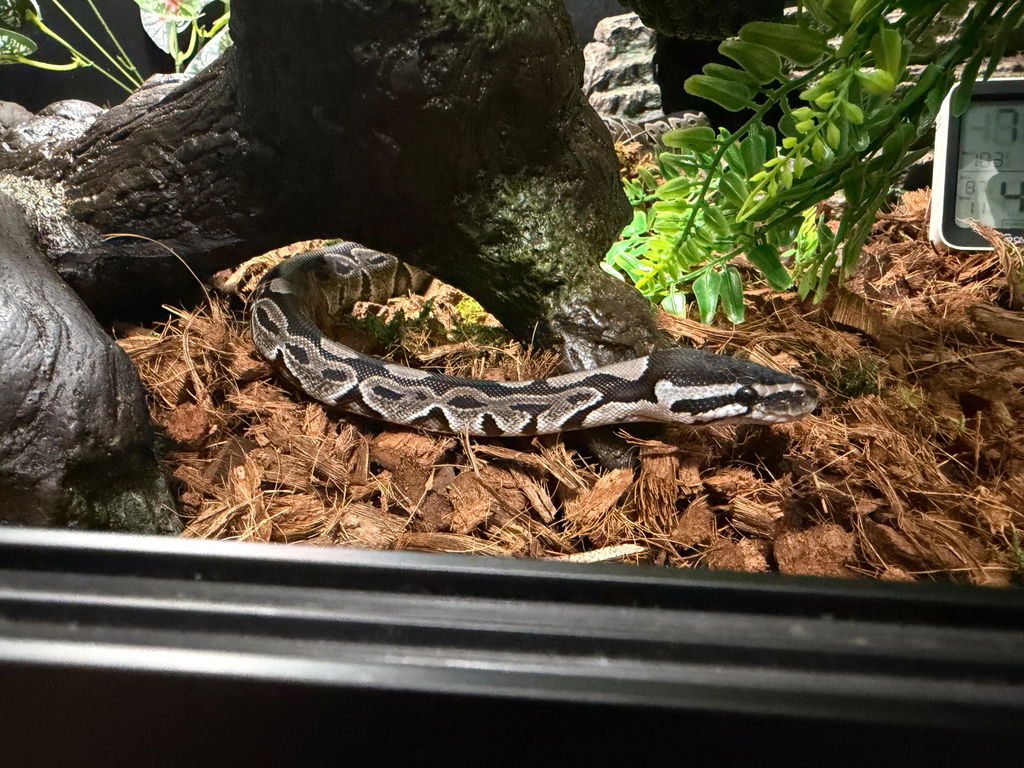
The clown ball python is one of the most distinctive and desirable morphs in the entire ball python hobby. With its bold dorsal stripe, teardrop head markings, and rich golden coloration, the clown morph stands apart from virtually every other genetic mutation — and it only gets better with age. Unlike most ball pythons that darken and dull over time, clown ball pythons actually become more vivid and attractive as they mature. That's a rare quality that makes them equally appealing to first-time buyers looking for a beautiful pet and serious breeders building long-term genetic projects.
We've worked with clown ball pythons at Ghost Constrictors for years, and we consistently recommend them as one of the best morphs to own and breed. Here's a deep dive into what makes clowns special, how the genetics work, the most popular combos, and what to look for when you're ready to buy one.
What is a clown ball python and where did the morph originate?
A clown ball python is a color and pattern mutation first discovered in a wild-caught African import by Dave and Tracy Barker of Vida Preciosa International (VPI) in 1996. The animal had an unusual teardrop marking beneath its eye — the "clown face" that gave the morph its name. After acquiring additional animals with the same trait in 1997, the Barkers began a careful breeding program. They bred the original male to normal females and got all normal-looking offspring, which confirmed the trait was recessive rather than co-dominant. In 1999, when those offspring were bred together, the first captive-bred visual clowns were produced.
Early clowns were extraordinarily expensive — original breeding stock sold for $20,000 to $30,000 in the late 1990s. By the mid-2000s, visual clowns were still commanding several thousand dollars each. Today, thanks to decades of breeding, you can buy a beautiful single-gene clown for $100 to $300, making them one of the best values in the hobby for the visual impact they deliver.
How clown ball python genetics work
The clown gene is simple recessive, meaning the snake must inherit two copies — one from each parent — to display the visual clown phenotype. A snake with only one copy is a "het clown" that looks like a normal ball python but carries the gene internally.
At the molecular level, the clown mutation affects the melanocortin receptor (Mc1R), reducing melanin production and changing how pigment distributes across the body during development. Instead of producing primarily dark eumelanin, affected cells shift toward producing lighter pheomelanin. This is why clowns display warm golden and copper tones rather than the typical dark browns and blacks, and why the dark pigment that remains concentrates into that signature thick dorsal stripe.
Breeding outcomes follow predictable ratios. Two visual clowns bred together produce 100% clown offspring. A clown bred to a het clown produces roughly 50% visual clowns and 50% het clowns. Two het clowns bred together yield about 25% visual clowns, 50% het clowns, and 25% normals. Unlike some morphs, there are no known health issues associated with the clown gene — no wobble, no neurological problems, no reduced fertility. That makes clowns one of the most ethical and worry-free morphs to work with.
What clown ball pythons look like and why they're unique
The defining visual feature of a clown ball python is the wide, dark dorsal stripe that runs from the head down the length of the body to the tail. Normal ball pythons have an "alien head" saddle pattern on their sides — clowns replace that with reduced, splotchy lateral markings that range from teardrop-shaped blotches to nearly patternless flanks. The head is busy and distinctive, with dark markings above the lips, beneath the eyes, and across the crown. That "comical" head pattern is one of the easiest ways to identify a clown at a glance.
The base coloration runs golden to copper, with crisp tans and warm browns. But the real magic of clowns happens over time. While most ball python morphs fade and darken with age, clowns lighten and intensify, often looking their best at three to five years old and beyond. This is the opposite of what happens with nearly every other morph, and it's one of the biggest reasons experienced keepers gravitate toward clowns.
Each clown is also uniquely patterned. Some have heavy lateral markings and a broken stripe. Others are nearly clean-sided with a solid, uninterrupted dorsal line. That individual variation means no two clowns look exactly alike, even within the same clutch.
Popular clown ball python combos worth the investment
The clown gene interacts beautifully with other morphs, and some of the most spectacular ball pythons ever produced are clown combos. The banana clown is a fan favorite — the banana gene transforms the warm golds into brilliant yellows and soft lilacs, creating a snake that looks almost unreal. The pastel clown brightens the overall appearance and lightens the dorsal stripe, while the killer clown (super pastel clown) takes that further with dramatically pale coloration and reduced pattern.
The enchi clown is a favorite among breeders because the enchi gene sharpens the dorsal stripe and enhances color intensity. The leopard clown adds deep orange tones and rich burgundy teardrops that hold their color into adulthood — many breeders consider this one of the most important clown combos for long-term projects.
For those chasing the highest-end genetics, double recessive combos like the clown pied and the albino clown command premium prices because producing them requires both parents to carry two recessive genes simultaneously. The odds of producing a visual double recessive from het-to-het pairings are just 1 in 16 per egg, which explains why these combos can run $1,000 to $5,000 or more. Other exciting combos include the desert ghost clown, the mojave clown, and the fire clown.
Clown ball python pricing and market trends
Today's clown market offers excellent value at every level. A single-gene clown ball python typically sells for $100 to $300, with females on the higher end due to breeding potential. Het clowns run $50 to $150. Popular two-gene combos like banana clowns and pastel clowns fall in the $200 to $400 range, while killer clowns can reach $500 to $2,000 depending on quality.
Triple-gene and quad-gene designer combos are where prices climb. Axanthic clowns command $2,000 to $5,000, and rare multi-gene combinations can push even higher. The clown gene is widely considered one of the best foundational genes for long-term breeding projects because it consistently adds visual impact to virtually every combination, holds its value in the market, and carries zero associated health concerns.
What to look for when buying a clown ball python
Start with the same fundamentals you'd evaluate in any ball python purchase: a solid feeding history on frozen-thawed prey, clear eyes, smooth scales, clean vent, and a responsive but calm temperament. For clowns specifically, take a close look at the quality of the dorsal stripe — a clean, well-defined stripe is generally more desirable than a broken or irregular one, though this comes down to personal preference.
If you're buying a het clown for a future breeding project, be aware that there are no reliable visual markers for het clown status. The only way to confirm het status is through lineage verification or test breeding. Buy your het clowns from a breeder who can document the parents' genetics, and always choose 100% hets over possible hets when building a project — the certainty is worth the slightly higher price.
Browse our clown ball python collection
If the clown morph has caught your eye, you're in the right place. Check out our clown ball pythons for sale — we produce single-gene clowns and multi-gene clown combos throughout the season, all captive bred and family raised at our facility in South Georgia. Every snake ships with free overnight FedEx on orders over $150, a live arrival guarantee, and the kind of personal support you only get from a family-owned breeder with over a decade of experience and 227 verified five-star reviews. Whether you're buying your first clown or adding the next piece to a breeding project, browse our current ball pythons for sale and reach out with any questions — we're always happy to talk snakes.
Looking at other morphs? See our Complete Ball Python Morph Guide, our Pied Ball Python breakdown, and our Spotnose Ball Python guide.