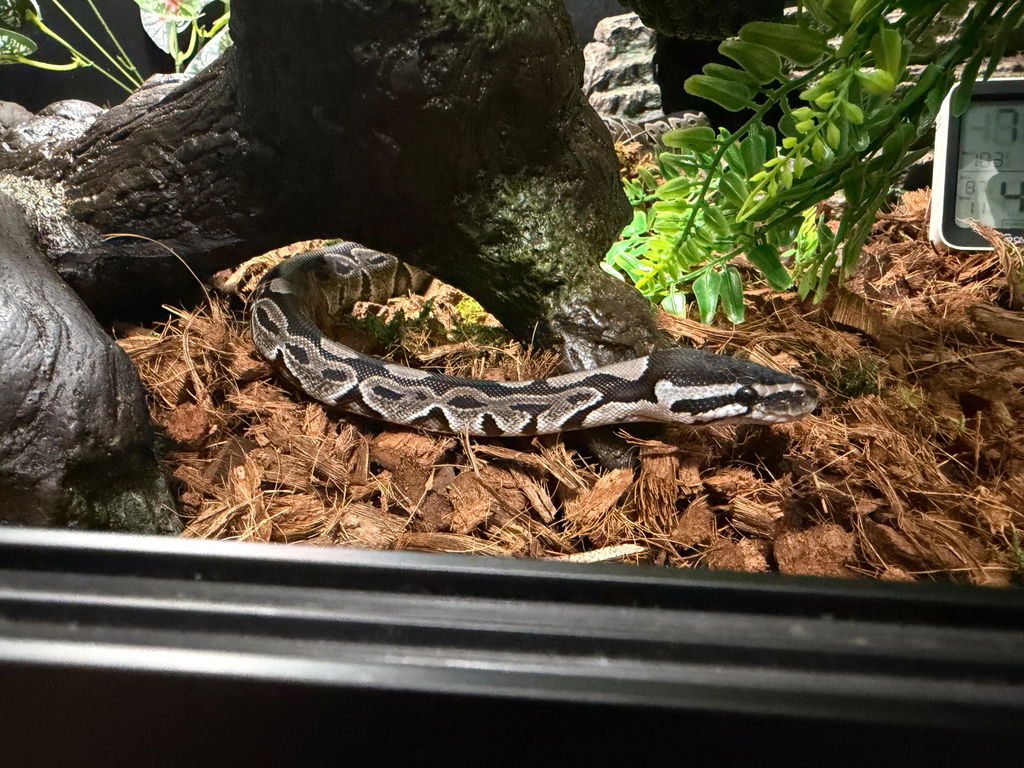
Getting your ball python enclosure setup right from day one is the single most important thing you can do as a new keeper. After more than ten years of breeding ball pythons here in South Georgia, we've seen firsthand how the right habitat makes the difference between a snake that thrives and one that struggles with feeding refusals, respiratory infections, and chronic stress. At Ghost Constrictors, we raise every one of our animals in carefully controlled environments before they ship to your door, and we want your setup to match that same standard. This guide walks you through everything we've learned from managing hundreds of enclosures — not theory from a textbook, but real-world experience from a working breeding facility.
Why your enclosure choice matters more than you think
The enclosure you choose determines how easily you can control temperature and humidity, which are the two factors that drive almost every aspect of ball python health. We recommend PVC or plastic enclosures for most keepers. They hold heat and humidity far better than glass aquariums, and they give your snake the sense of security it needs. A 4-foot by 2-foot by 2-foot enclosure is the minimum for an adult ball python, and front-opening doors make feeding and maintenance much simpler.
Glass tanks can work, but they come with challenges. Screen tops leak humidity and make temperature gradients harder to maintain, especially in dry climates or homes with central air conditioning. If you go with glass, plan to cover most of the screen top with aluminum foil or a cut piece of acrylic and line the back and sides with a background or black construction paper. Your snake will feel exposed in a clear-walled tank without these modifications.
For baby and juvenile ball pythons, smaller enclosures actually work better. A large space can stress a young snake and make it reluctant to eat. We start our hatchlings in 6-quart tubs and move them up as they grow. There's nothing wrong with a tub setup — most professional breeders use them, and the snakes do beautifully in them. The key is that the snake can thermoregulate, access clean water, and feel hidden and secure. If you're managing more than one or two animals, a proper PVC rack system like the ones Rack Theory builds makes tub-based housing far more manageable than assembling individual setups one at a time.
Getting temperature and heating right
Ball pythons need a warm side between 88–92°F and a cool side around 76–80°F. This gradient lets the snake move between zones to regulate its own body temperature, which is essential for digestion and immune function. At night, temperatures can drop a few degrees, but the warm side should never fall below 85°F.
We use a combination of heat tape and overhead heating depending on the enclosure type. For PVC and tub setups, heat tape or heat mats connected to a thermostat work well. For larger display enclosures, a halogen flood bulb or deep heat projector provides a more natural heat gradient from above. Whichever method you choose, a thermostat is not optional — it's mandatory. Unregulated heat sources cause burns, and we've seen keepers bring us photos of belly burns that could have been prevented with a $30 thermostat.
Avoid heat rocks entirely. Ceramic heat emitters work but produce no light, so pair them with a low-wattage LED on a timer if you want a day-night cycle. Most ball pythons benefit from roughly twelve hours of light and twelve hours of darkness, which mimics their natural rhythm in West Africa.
Humidity is the most underrated factor in ball python health
If we could tell every new ball python owner just one thing, it would be this: get your humidity right and most other problems disappear. Aim for 60–80% ambient humidity at all times, with a humid hide available that stays above 80%. This prevents stuck sheds, respiratory issues, and dehydration — the three most common health problems we see in pet ball pythons.
Here in South Georgia, our ambient humidity is naturally high for much of the year, which means our snakes get a head start. If you live in a drier climate — Arizona, Colorado, or anywhere that runs a furnace all winter — maintaining humidity takes more effort. A PVC or plastic enclosure helps enormously. Pair that with a moisture-holding substrate, a large water bowl placed on the warm side to encourage evaporation, and periodic misting, and you'll be in good shape.
Invest in a digital hygrometer with a probe you can place inside the enclosure. The stick-on analog gauges sold at pet stores are notoriously inaccurate and can read 15–20% off. If you're going to monitor one parameter obsessively, make it humidity.
Substrate, hides, and décor that actually work
For substrate, we recommend coconut husk or a cypress mulch and coconut fiber mix. Both hold moisture well and resist mold when kept at proper humidity levels. Lay it three to four inches deep so your snake can burrow. Avoid aspen shavings if your humidity target is above 60% — aspen molds quickly in humid conditions. Never use cedar or pine, as the oils are toxic to reptiles.
Every ball python needs at least two hides: one on the warm side and one on the cool side. The hides should be snug. Ball pythons feel secure when they can press against the walls of their hide on all sides. Oversized hides are essentially useless, and a snake without a proper-fitting hide will stay stressed and often refuse food. Cork bark, half logs, and commercial reptile hides all work. We use simple dark hides in our facility because they're easy to sanitize.
Add a large water bowl that your snake can soak in if it chooses but cannot tip over. Branches and cork rounds provide climbing opportunities, which ball pythons use more often than people expect. Enrichment matters — a ball python with things to explore is a more active, healthier animal.
Common enclosure mistakes we see every week
After a decade of talking with customers and troubleshooting setups, the same mistakes come up again and again. The first is relying on a heat lamp without a thermostat. We cannot stress this enough. The second is placing the water bowl on the cool side where it doesn't contribute to humidity. Move it to the warm side and you'll see your humidity readings improve immediately.
Another common problem is enclosures that are too large for young snakes, with too few hides and too much open space. A baby ball python in a 40-gallon tank with two hides tucked in corners will feel exposed and refuse to eat. Start smaller and scale up. We also see keepers using screen-top aquariums without modifications, then wondering why their humidity sits at 30%. If the top of your enclosure is mesh, you're fighting a losing battle unless you cover at least 75% of it.
Finally, don't skip quarantine. If you already have reptiles, keep your new ball python in a separate room with dedicated tools for at least 60–90 days. Diseases like nidovirus and inclusion body disease can devastate a collection, and symptoms aren't always obvious right away.
Your setup checklist before bringing a ball python home
Before your snake arrives, your enclosure should already be dialed in. Run your heating and thermostat for at least 48 hours to make sure temperatures are stable. Confirm your humidity is consistently in the 60–80% range. Have both hides in place, substrate laid, water bowl filled, and a digital thermometer and hygrometer reading accurately.
When the snake arrives, place it in the enclosure and leave it alone for five to seven days. Don't handle it, don't peek under hides, don't offer food. Let it explore and settle in on its own schedule. That first week of undisturbed acclimation sets the tone for everything that follows.
If you're looking for a well-started, captive-bred ball python that's already feeding on frozen-thawed and raised in optimal conditions from day one, browse our full collection of ball pythons. Every snake we ship from Ghost Constrictors comes with our live arrival guarantee and care support from our family to yours.
For more on care basics, see our Ball Python Care Guide, our Enclosure Size Guide, and our Humidity Guide.