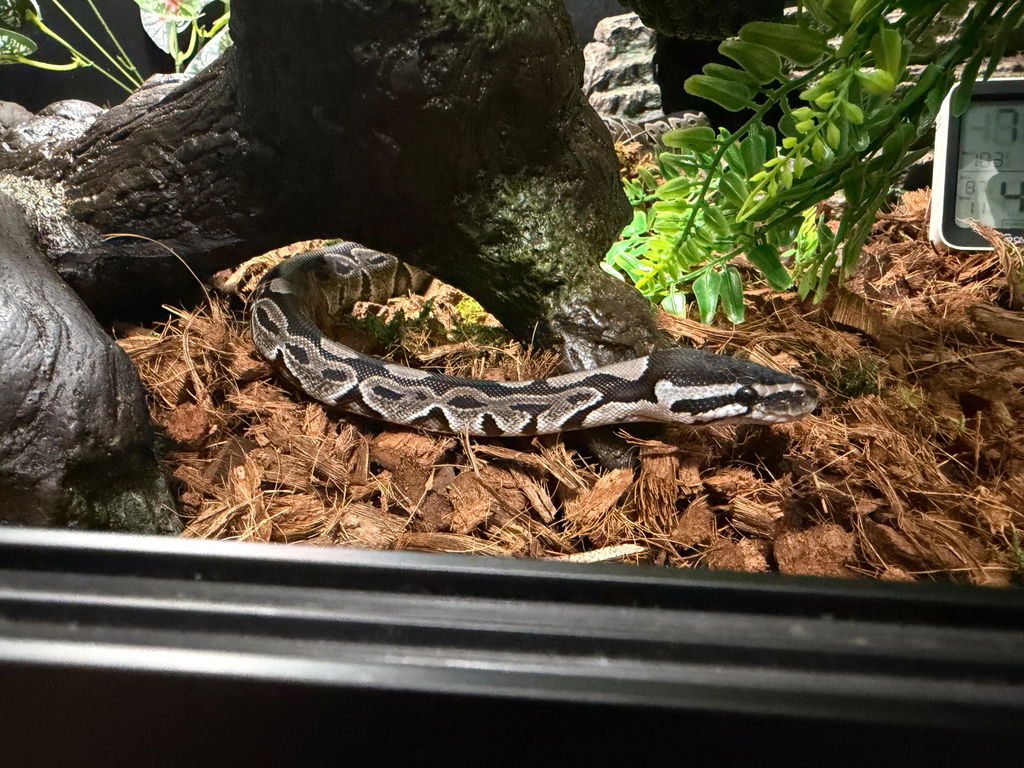
The Enchi ball python is one of the most useful and widely worked genes in the entire hobby — not because it's flashy on its own, but because of what it does to everything it touches. At Ghost Constrictors, Enchi ball pythons run through a huge share of our combo projects, and in this guide we cover the genetics, the best combinations, current pricing, and what to expect if you're adding one to your collection.
What an Enchi ball python looks like
A single-gene Enchi is subtle compared to many other morphs — it's easy to miss on a hatchling if you're not looking closely. The gene brightens the gold and orange tones along the sides, gives the dark pigment a chocolate rather than black cast, and reduces pattern slightly, giving the "alien head" markings a copper or bronze tint. Enchi is one of the rare genes that improves with age rather than fading — the color intensifies as the snake matures, which is unusual in a hobby where most morphs are at their brightest as hatchlings.
Enchi genetics: an incomplete dominant gene from Ghana
Enchi originates from a pair of wild-caught ball pythons imported from the Enchi region of Ghana in the late 1990s, first proven out as a genetic trait by Swedish breeder Lars Brandell in 2002. Genetically, Enchi is incomplete dominant — a single copy of the gene produces the visual Enchi appearance, and two copies (Super Enchi) produce a more intensely colored, more pattern-reduced animal. That means every Enchi you see for sale is a het carrier in disguise as far as breeding goes — pair an Enchi to any other ball python and roughly half the clutch will carry the visual gene.
The best Enchi combos
Enchi's real value shows up in combination, where it brightens color and cleans up pattern in almost anything it's paired with. Enchi Pastel and Super Enchi Pastel are classic starting points, stacking two color-brightening genes for a genuinely vivid animal. Enchi Mojave and Enchi Fire lean into pattern reduction, while Banana Enchi combines two of the most popular color genes in the hobby into an especially bright animal.
We work Enchi into a wide range of our own projects — Black Head Enchi, Chocolate Enchi, Champagne Enchi, and Enchi paired with Yellow Belly and Hypo are all combinations we've produced, each pulling something different out of the base Enchi color enhancement.
Enchi prices and what drives value
Single-gene Enchi is one of the more affordable morphs in the hobby, reflecting how common and easy to produce it's become. Combo animals scale up from there based on what else is stacked in — our own Enchi combinations have ranged from around $315 for simpler two-gene animals up to $500 and beyond for more complex combinations like Champagne Enchi or animals carrying Super Pastel and Butter alongside Enchi. As with any morph, price is driven by gene count, visual quality, sex, and proven versus unproven het status on any recessive traits carried alongside it.
Caring for an Enchi ball python
Enchi ball pythons have identical care requirements to any other ball python morph — the gene affects color and pattern only, not temperament, feeding response, or health. Warm side 88 to 92 degrees, cool side 76 to 80, humidity 60 to 80 percent, moisture-retaining substrate, two snug hides, clean water bowl. Feed appropriately sized frozen-thawed rats every 7 to 10 days for juveniles and every 10 to 14 days for adults.
If you're interested in adding Enchi genetics to your collection — whether as a bright standalone animal or as the backbone of a combo project — explore our Enchi ball pythons at Ghost Constrictors. We breed these animals in our South Georgia facility and ship overnight with a live arrival guarantee. Browse our full collection and reach out any time with project questions.
Want to see more morphs? Check out our Complete Ball Python Morph Guide, our Pastel Ball Python breakdown, and our Desert Ghost Ball Python guide.