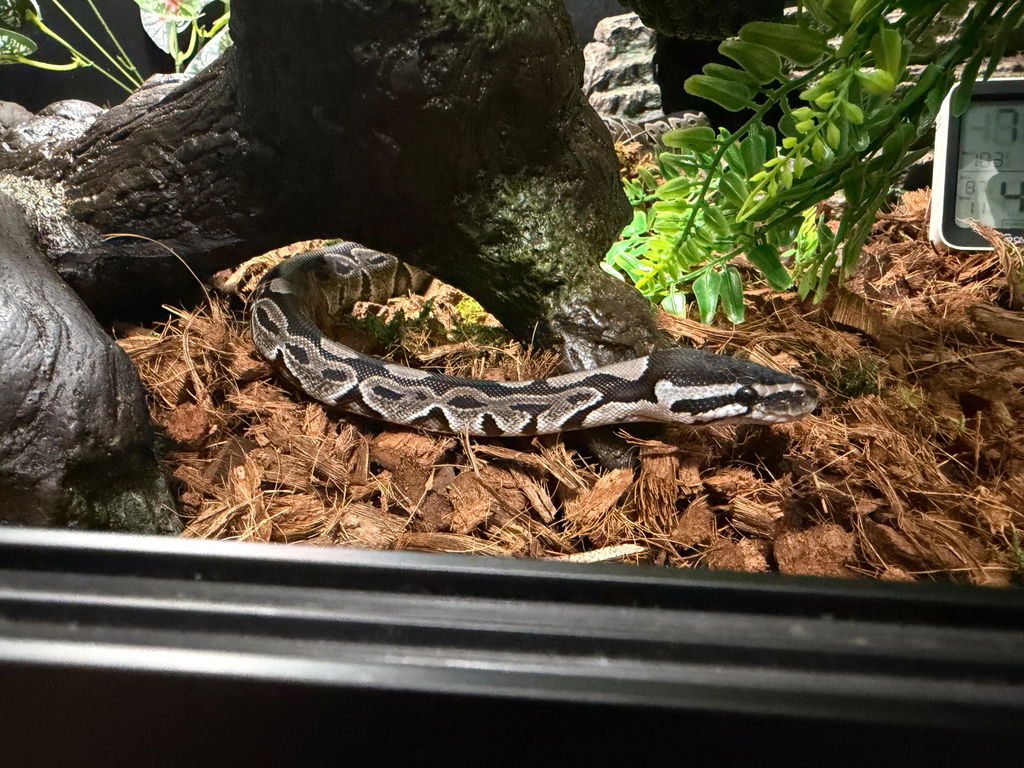
Whether you're buying from a breeder, a reptile expo, or online, knowing how to assess a ball python's health before you commit is the most important skill you can have as a buyer. A healthy animal is a good experience; an unhealthy one is an expensive, stressful introduction to reptile ownership.
Here's exactly what to look for.
Eyes
The eyes should be clear, bright, and symmetrical. Ball pythons have smooth, clear eye scales (called spectacles) that should have no cloudiness, discharge, or retained shed.
Exception: A snake that's in shed (in "blue") will have cloudy eyes — this is normal and temporary. If you're evaluating an animal in blue, ask to come back after the shed or ask the seller to hold the animal until the shed is complete before you make a final decision.
Red flags: Swollen eyes, asymmetrical eyes, sunken eyes, or discharge around the eye area.
Body Condition
Run your hand gently along the spine. You should feel the spine but not see it. Visible spinal ridges from the side indicate an underweight animal that hasn't been fed adequately.
The body should feel firm and muscular, not loose or doughy. The skin should lay flat without visible folds or excess looseness.
Look at the tail. The tip should taper normally to a clean point. Discoloration, pinching, or abnormal tapering at the tail tip can indicate retained shed that has cut off circulation.
Red flags: Visible spine, loose or excessively thin body, tail tip discoloration.
Skin and Scales
The scales should lay flat and smooth with no bubbling, discharge, or unusual texture. Look for any mites — tiny black or red dots moving on the skin, especially around the eyes and under the chin.
Mites are treatable but are a sign of poor husbandry conditions at the source and mean the animal has been stressed. If you see mites on one animal at a table or facility, assume all animals there are exposed.
Red flags: Bubbling or raised scales (possible infection), any moving dots on the skin, discharge from any scale area.
Mouth and Respiratory
Watch the animal breathe. Breathing should be silent and effortless. Any wheezing, clicking, or audible breathing indicates a respiratory infection.
Look at the mouth. It should close completely and cleanly. Mucus around the mouth or nostrils, or a mouth that won't close properly, are signs of mouth rot (infectious stomatitis) or respiratory infection.
Red flags: Any audible breathing, mucus around mouth or nostrils, gaping mouth.
Behavior
A healthy ball python should be alert when disturbed from rest. It should respond to your presence with a flicking tongue (scent detection) and controlled, purposeful movement.
Extreme defensiveness — striking repeatedly from a tightly coiled position — can indicate a stressed or poorly socialized animal, though some hatchlings and juveniles are naturally defensive and calm down with handling.
A completely limp, unresponsive animal is a significant red flag regardless of any other factors.
Neutral: Balling up (tucking head) is a defensive behavior, not a health problem. Red flag: Completely unresponsive, inverted posture (rolling onto back), star-gazing (head bent backward) which indicates neurological problems.
Feeding History — Ask Before You Buy
This is the question most buyers forget to ask: "When did this animal last eat, and what was it fed?"
A healthy ball python from a responsible breeder should have a documented feeding history. You want to know it's feeding on frozen/thawed prey (not live), that it ate recently, and that it's doing so consistently.
Vague answers — "it should be eating" or "it was eating last time I checked" — are red flags. A reputable breeder knows exactly when each animal last ate.
Buying Online: What Changes
When buying online, you can't physically inspect the animal. What you're relying on instead:
-
Current photos and video. Ask for them if the listing photos look dated. Any reputable seller will send them.
-
Feeding documentation. Ask for the feeding log or at minimum a confirmed recent feeding date.
-
Seller reviews. This is your primary health proxy when buying sight-unseen. A seller with 200 detailed positive reviews has a track record that tells you more than a physical inspection of one animal.
-
Live arrival guarantee. Your safety net if something goes wrong in transit.
At Ghost Constrictors, every animal we ship has a documented feeding history, known genetics, and is covered by a live arrival guarantee. We're happy to provide current photos and video of any animal before you commit.
Browse Ball Pythons for Sale →
For more on care basics, see our Ball Python Care Guide, our Weight & Growth Chart, and our guide on How Long Do Ball Pythons Live.