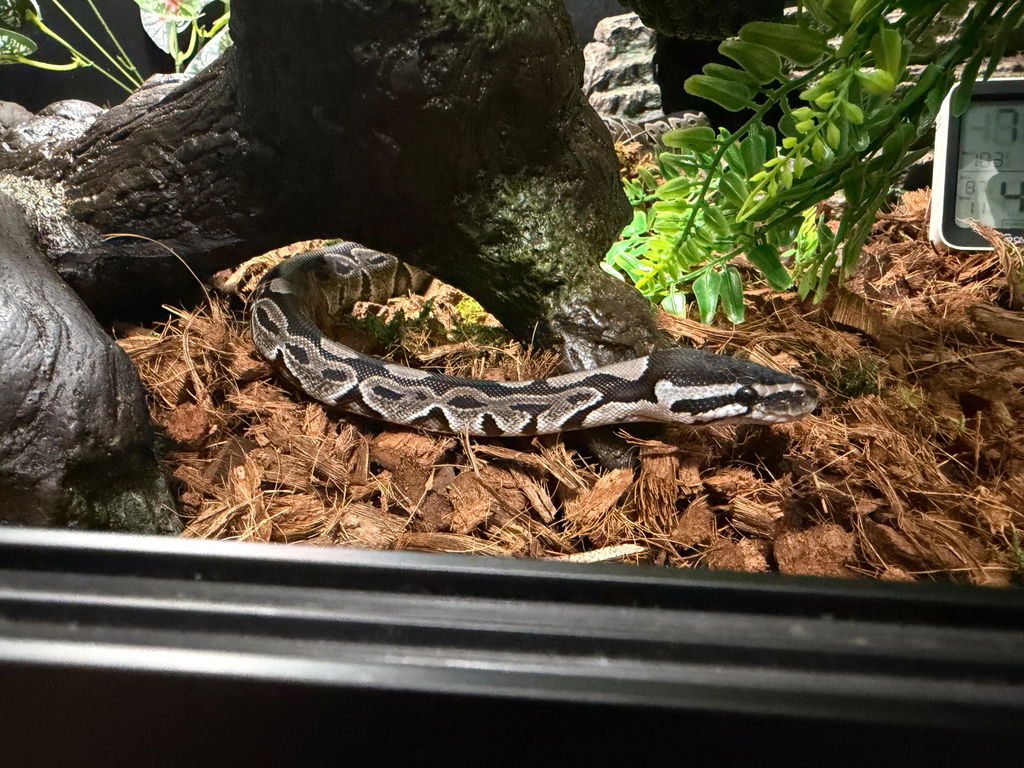
If you're shopping for your first pet snake, two species come up in almost every conversation: ball pythons and corn snakes. Both are beginner-recommended, widely available, and well-studied in captivity. Both make genuinely good pets. But they're not the same animal, and the right choice depends on who you are and what you want out of the experience.
Here's an honest, side-by-side comparison.
Size and Handling
Ball pythons are stocky, medium-sized snakes. Adults typically reach 3–5 feet and 1,500–2,500 grams. They're thick-bodied and feel substantial in your hands — not in a scary way, but in a solid, present way. They move slowly, coil calmly on a warm arm, and are generally described as the "perfect weight" for handling. Males are smaller; females are significantly larger.
Corn snakes are slender and longer — adults commonly reach 4–5 feet but with much less body mass. They're lightweight, fast-moving, and active. Corn snakes are often described as more "wriggly" — they explore constantly during handling and are quicker to move around than a ball python.
Verdict: If you want a calm, heavy-bodied snake that sits and coils while you hold it, ball python wins. If you prefer an active, curious snake that's always on the move, corn snake might suit you better. Neither is inherently harder to handle — they're just different experiences.
Temperament
Ball pythons have a well-earned reputation as calm, docile animals. When stressed, they don't typically bite — they ball up (hence the name), tucking their head inside a tight coil. This defensive behavior is harmless and usually stops once the animal is handled regularly and becomes comfortable. Well-established ball pythons almost never show any defensive behavior. They're described by experienced keepers as "dogs of the snake world" in terms of temperament.
Corn snakes are also docile as adults, but hatchlings and juveniles can be nippy. They're more likely to musk (release a foul-smelling secretion when alarmed) than ball pythons. With consistent handling, corn snakes become very tame — but the early period can be more eventful than with a ball python.
Verdict: Ball pythons have a more reliably calm temperament from an earlier age. Corn snakes get there with handling but may require more patience initially.
Care Requirements
This is where things diverge meaningfully.
Temperature
Ball pythons require a warm side of 88–92°F (surface temperature) and a cool side of 76–80°F ambient. They are tropical animals from sub-Saharan Africa and do not tolerate cold. Proper heating requires an under-tank heater or heat tape on a thermostat. This is non-negotiable.
Corn snakes come from North America and are more forgiving on temperature — a warm side of 80–85°F and a cool side around 70–75°F is sufficient. They can tolerate lower temps than ball pythons, which makes their heating setup simpler and more forgiving.
Humidity
Ball pythons require 60–80% humidity, which is higher than most typical home environments. This usually means using a substrate that holds moisture (coconut fiber, cypress mulch), covering most of the screen top, and misting when needed. Keeping humidity up is one of the most common challenges new ball python keepers face.
Corn snakes are much more forgiving — 40–60% is fine, which is often the ambient humidity in most homes. Minimal intervention required.
Feeding
Ball pythons are notorious for their feeding quirks. They can go off food for weeks or months during breeding season (October–February) and some individuals are picky regardless of season. This is one of the most common stressors new ball python owners experience, and it's worth knowing upfront. The good news: a healthy adult ball python can go months without food without health consequences. But it's stressful to watch.
Corn snakes are voracious, reliable feeders. They almost always eat when offered and rarely refuse. For a first-time keeper who wants an animal that gives them consistent positive feeding experiences, corn snakes have a significant edge here.
Enclosure Size
Both species do well in similar enclosure footprints for adults — a 4'x2' is suitable for either. Ball pythons often do better in more enclosed, less open enclosures (they prefer security). Corn snakes appreciate vertical space and height to climb.
Morph Availability and Visual Appeal
This is where ball pythons pull away decisively.
Ball pythons have the most developed morph market of any reptile species in the hobby — hundreds of distinct genetic morphs, thousands of combinations, and a breeding community that produces new combinations every year. Whether you want a brilliant yellow Banana, a pure white Blue Eyed Leucistic, a pattern-reduced Clown, or a rare multi-recessive project animal, ball pythons offer it at every price point.
Corn snakes also have a respectable morph market — Okeetee, Snow, Amel, Lavender, Tessera, and many others. But the depth of ball python genetics is simply unmatched in the reptile world.
Verdict: If visual variety, genetics, and the potential to breed are part of your interest, ball pythons win this category without contest.
Lifespan
Ball pythons commonly live 20–30 years in captivity, with records over 40. This is a long-term commitment. The animal you buy this year will likely be with you for a significant portion of your adult life.
Corn snakes live 15–20 years in captivity. Still a serious commitment, but shorter than a ball python.
Verdict: Both require long-term planning. Ball pythons are a bigger commitment by time.
Cost
Ball pythons range from $50 for a normal up to thousands for rare morphs. Setup costs run $200–$400 for a quality hatchling enclosure. The heating requirements add a small but real ongoing electricity cost.
Corn snakes are similarly priced at the entry level, with simpler care requirements that translate to slightly lower setup costs. The heating and humidity demands are less.
Verdict: Comparable at entry level. Ball python setup is slightly more involved; corn snake care is slightly simpler.
Side-by-Side Summary
|
Ball Python |
Corn Snake |
|
|---|---|---|
|
Adult size |
3–5 ft, stocky |
4–5 ft, slender |
|
Temperament |
Calm, balling defense |
Docile when established |
|
Temp requirements |
88–92°F warm side |
80–85°F warm side |
|
Humidity |
60–80% (requires management) |
40–60% (easy) |
|
Feeding reliability |
Can be finicky |
Reliable eater |
|
Morph selection |
Unmatched |
Good but limited |
|
Lifespan |
20–30+ years |
15–20 years |
|
Beginner difficulty |
Moderate |
Easy |
Which One Is Right for You?
Choose a corn snake if:
-
You want the simplest possible care requirements
-
You want a snake that eats reliably and rarely causes feeding anxiety
-
You're less interested in morph genetics
Choose a ball python if:
-
You want a calm, heavy-bodied snake that's satisfying to hold
-
You're drawn to the world of morphs and potential future breeding
-
You want an animal you'll have for decades
-
You want access to the deepest and most developed morph market in the reptile hobby
Both are excellent choices. We just happen to specialize in one of them.
Ghost Constrictors has been producing quality ball pythons for over ten years — from beginner-friendly morphs under $150 to rare project animals. Every animal comes with documented genetics, a feeding history, overnight shipping, and a live arrival guarantee.
Browse Ball Pythons for Sale →
For more on buying with confidence, see our Ball Python for Sale Online page, our comparison of Ball Python vs. Boa Constrictor, and our page on What's Included When You Buy From Us.